The African supply chain fuel shock is exposing structural weaknesses across agriculture, freight, aviation, shipping and retail markets in 2026.
Across African markets, it is exposing how different layers of the supply chain absorb pressure, transfer cost, and respond to structural disruption.
While the immediate impact is visible through inflation and household budget pressure, the more important signals are emerging deeper within agriculture, freight, aviation, shipping and retail.
Five developments stand out.
In South Africa, diesel makes up between 12% and 18% of farm production costs. Coming as it did immediately ahead of harvest season, farmers haven’t been able to sequence fuel consumption around the price curve.
Beyond the price of fuel alone, fertiliser prices are moving in parallel, and the rand has weakened against the dollar at the same time. Three pressures are landing at once.
The African supply chain fuel shock is revealing how quickly multiple operational pressures can compound across agricultural markets.
The systemic nature of the shock becomes clearer here. A producer facing a single cost increase can usually absorb it. A producer facing fuel, fertiliser and currency simultaneously faces significantly greater strain.
Downstream, retail, FMCG and food services have felt this rise in input cost inflation immediately.
In April, the South African Freight and Logistics Association framed the shock not as a new problem but as a stress test.
Their view was that the surge is exposing pre-existing structural friction in the country’s logistics network. Issues like the rail-to-road imbalance, port-evacuation delays, and inefficient last-mile operations become more glaring. The African supply chain fuel shock is exposing long-standing weaknesses in regional freight infrastructure.
For business leaders watching the sector, roughly 80% of South African goods move by road, almost all of it diesel. Operators headed into May with diesel forecasts bracing for prices in nearer R35 per litre, a reality that, for now, has not yet arrived.
Some of the underlying exposure is currently being softened by temporary relief measures. Government has held the diesel levy at zero and extended fuel relief, partially masking the deeper structural vulnerability.
With the price of jet fuel more than doubling since the start of 2026, African airlines have effectively split into two groups.
Some carriers have the benefit of hedged supply, predictable contracts, and route-network depth. Many carriers in the second group are not in the same position. Across aviation markets, the African supply chain fuel shock is increasing operational uncertainty and pricing volatility.
We’ve seen the Airlines Association of Southern Africa (AASA) express grave concern over a lack of clarity regarding jet fuel supply. AASA has urged regional industry transparency about supply plans.
Nigeria has moved further, introducing price caps on jet fuel to keep airlines operating reliably.
Freight Forwarder operations are badly affected. Current capacity reductions and rate volatility on African air freight lanes are not seasonal, but structural, and will stay this way for as long as supply transparency remains weak.
Predictably, ocean carriers have introduced emergency bunker surcharges across major lanes, with bunker indices climbing through the first quarter.
According to analyses by the UN Conference on Trade and Development (UNCTAD), the Strait of Hormuz disruptions unfailingly feed back into global trade routes weeks later.
For African importers and exporters, landed cost is a moving target that is edging ever higher.
Surcharges are not exceptional anymore, and they are compounding with terminal and inland-haulage fuel inflation at both origin and destination.
Unfortunately, the consumer bears the brunt of the shock.
In South Africa, the basic food basket moved up R16 between March and April, and the transport channel alone is now estimated to exert roughly 4.4% upward pressure on food prices.
Broader system effects are pushing food inflation closer to 6–10%.
There’s a straight line from the fuel shock to the retail shelf. Input prices land on the shelf quickly, and any future decreases pass through far more slowly. The African supply chain fuel shock is now visibly translating into consumer pricing pressure across multiple sectors.
The pattern is not confined to South Africa. Kenya raised retail fuel prices by up to 24.2% on the back of crude exposure, and was forced to halve fuel VAT from 16% to 8% to soften the consumer impact.
Nigeria’s 5% fossil-fuel surcharge continues to contribute to broader cost-of-living pressure.
For retail, FMCG, and consumer-goods leaders, the shelf-side conversation about price cannot be separated from the supply-chain conversation about cost.
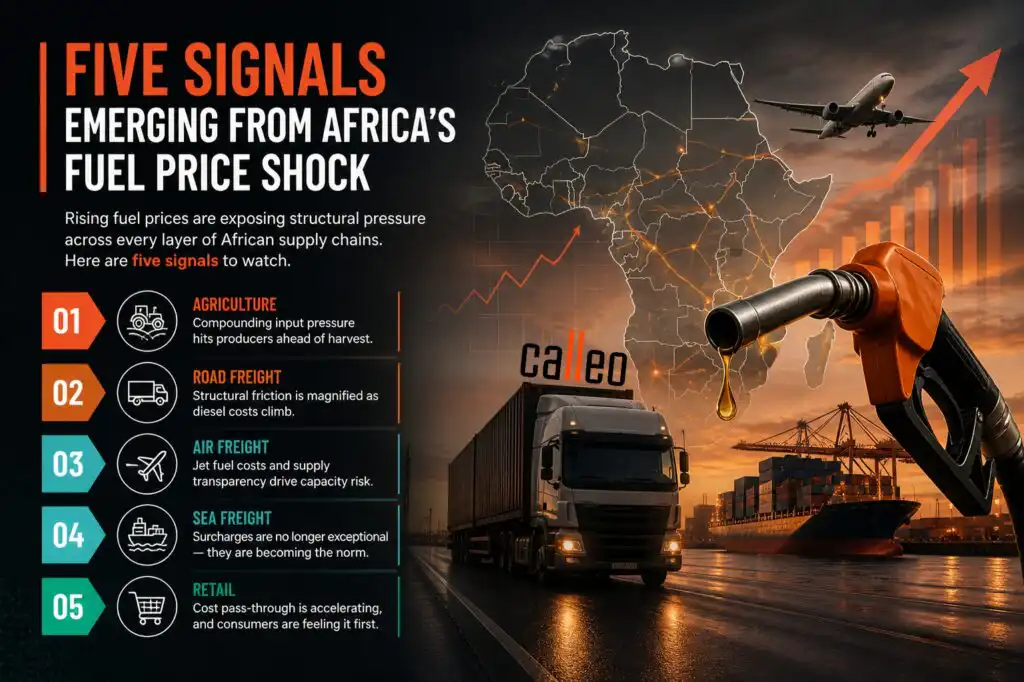
The African supply chain fuel shock is signalling something different at each layer of the market.
Agriculture is creaking under compounding inputs. Road freight is revealing structural friction. Aviation is suffering from fragmentation. Sea freight surcharges are now the norm, and retail is showing how quickly a systemic price shock can reach the consumer.
If your organisation is exposed to any one of these layers, the more valuable question is, “Where in the chain are we most exposed?”
The channels through which the fuel price shock transmits are already in view.
The value of market intelligence is no longer simply access to information. It is understanding which developments matter, how they connect, and what they could mean commercially before the broader market reacts.
At Calleo, we help organisations interpret the market signals shaping African logistics, infrastructure, retail and broader commercial ecosystems.
If your business is navigating changing supply-chain dynamics, operational pressure, or evolving market conditions, you can connect with the Calleo team here: https://calleosolutions.com/contact-us/

Tailored B2B information solutions. We collect and integrate vital intelligence, empowering your growth strategies and competitive edge. Accelerate your pathway to success.